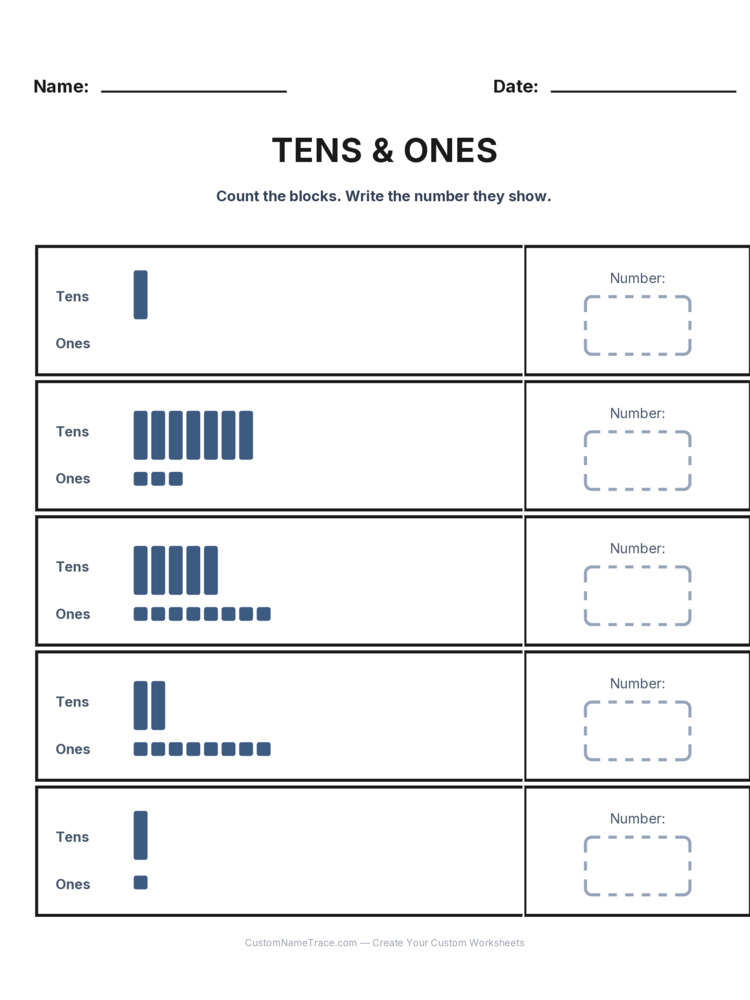
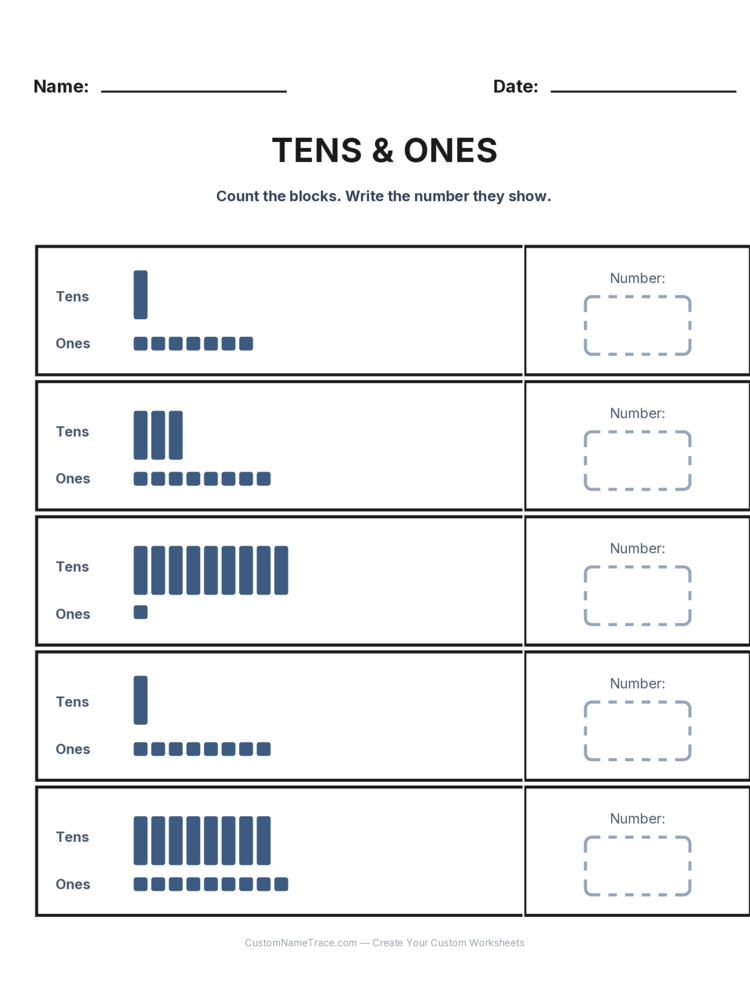
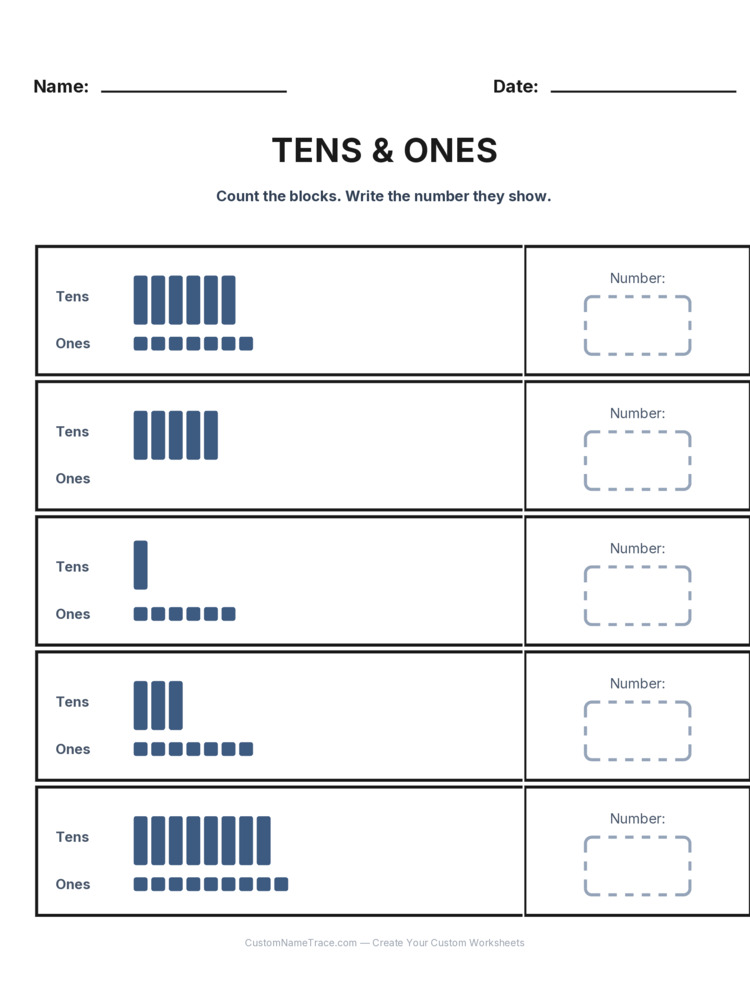
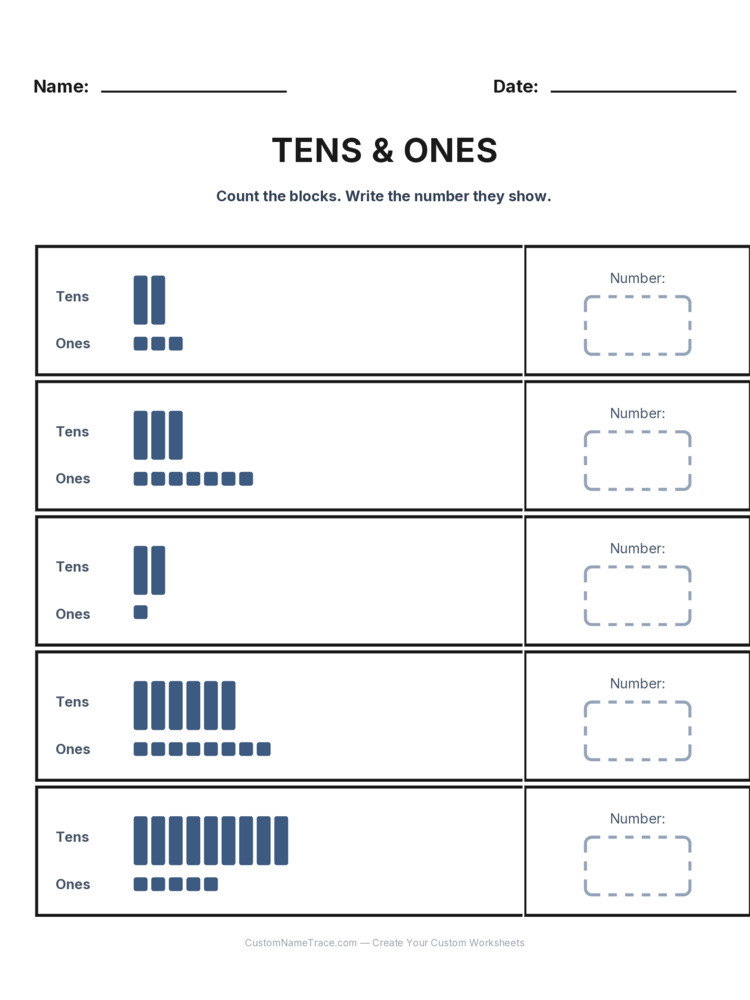
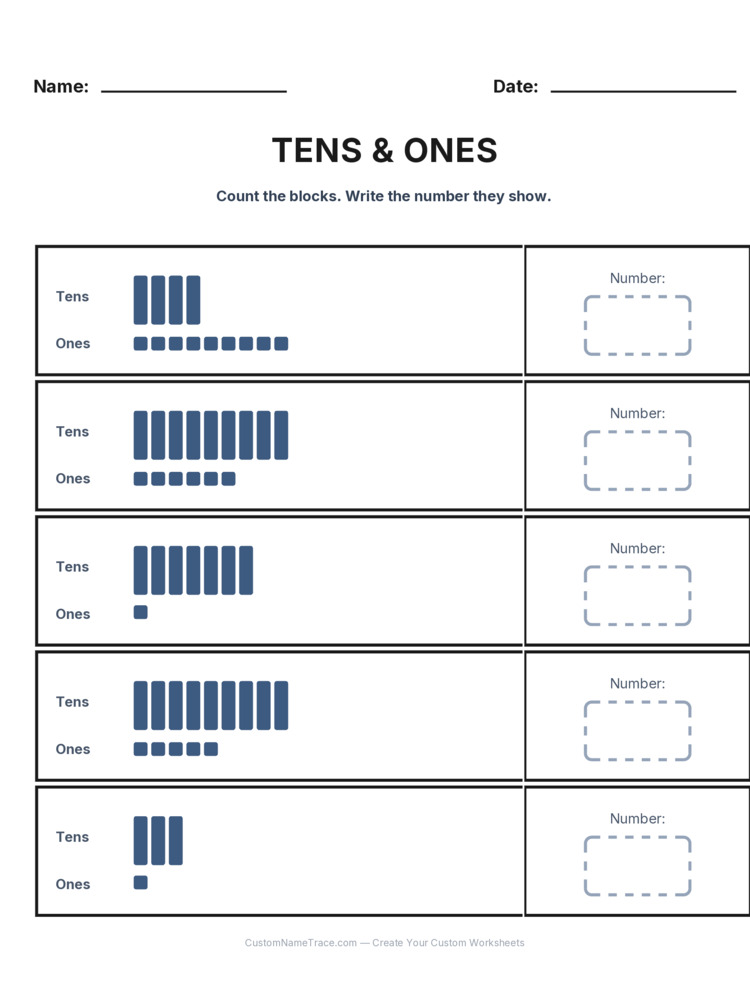
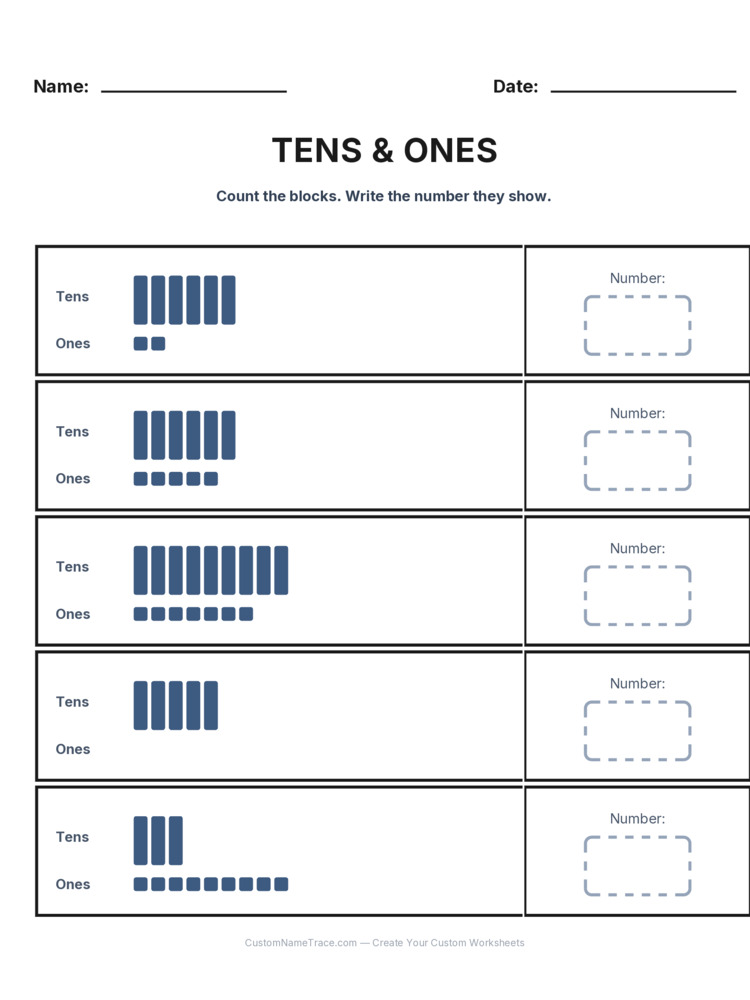
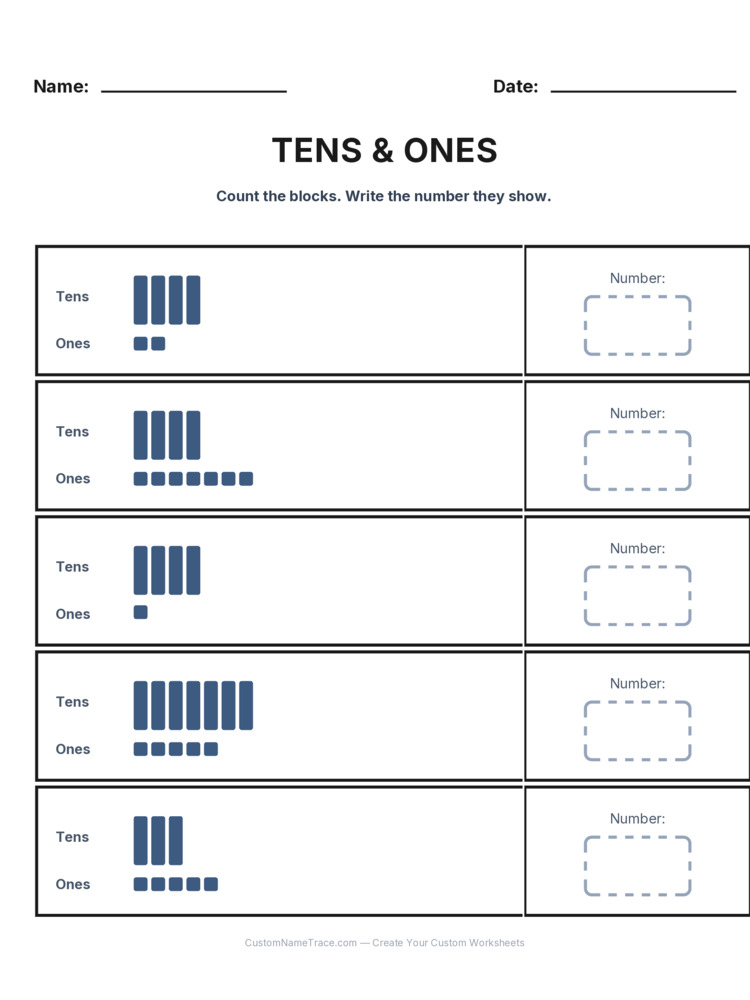
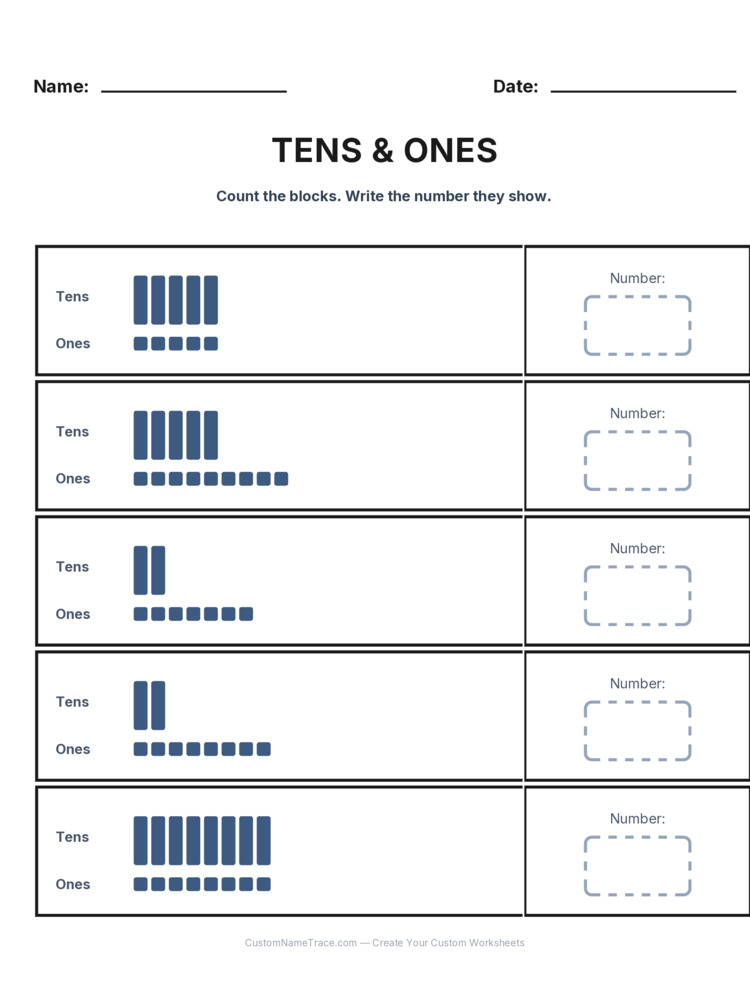
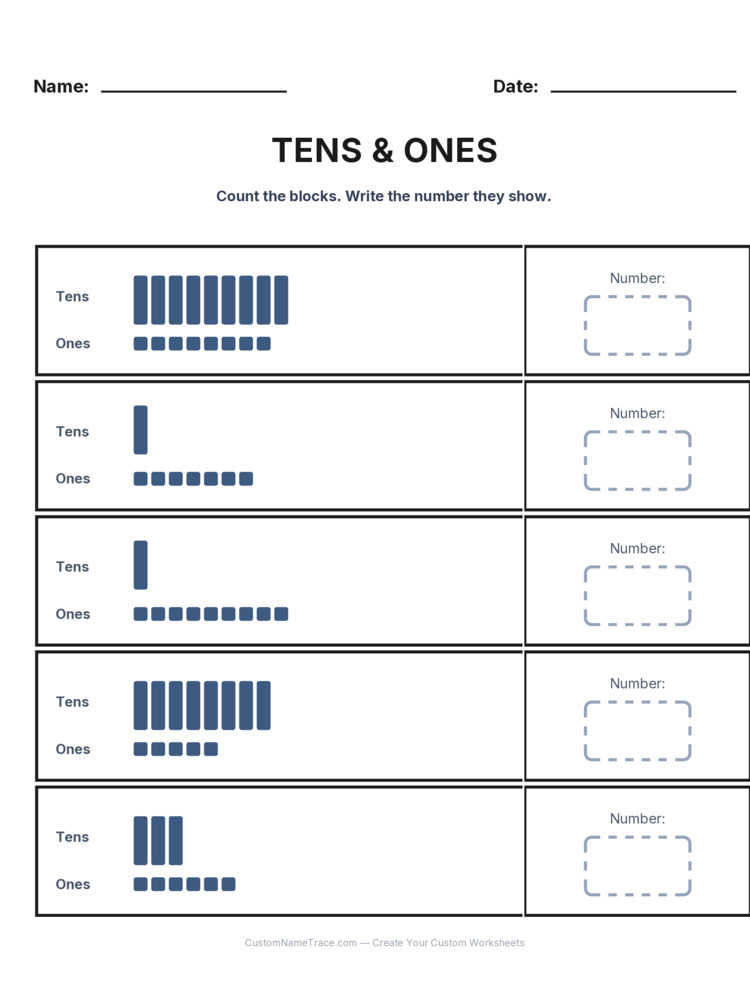
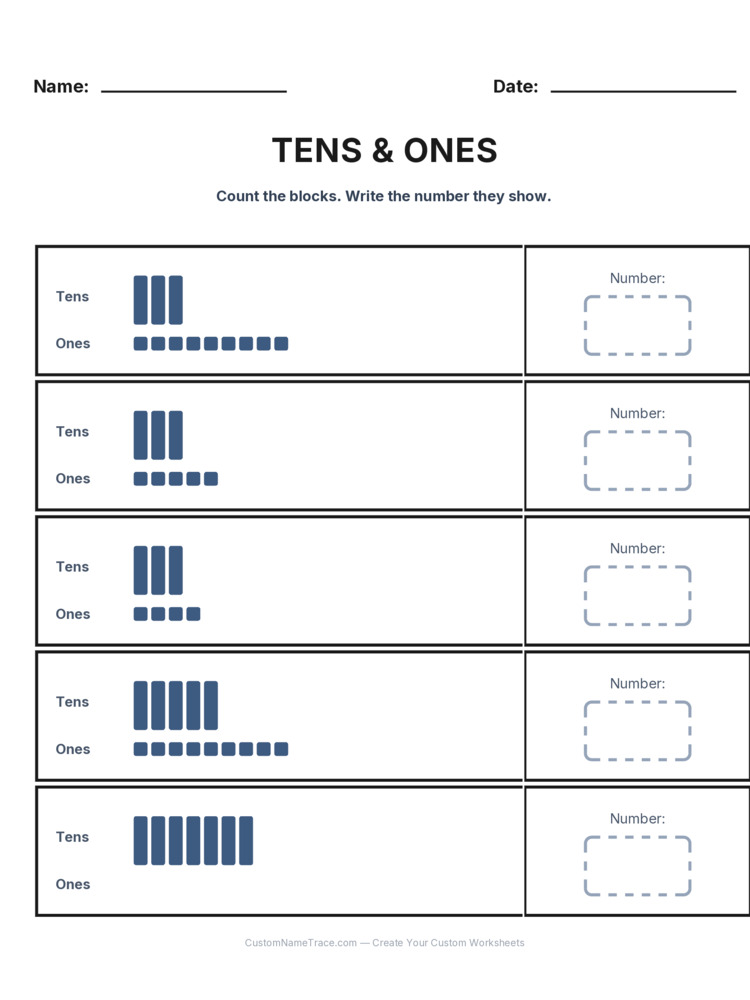
What these worksheets actually show
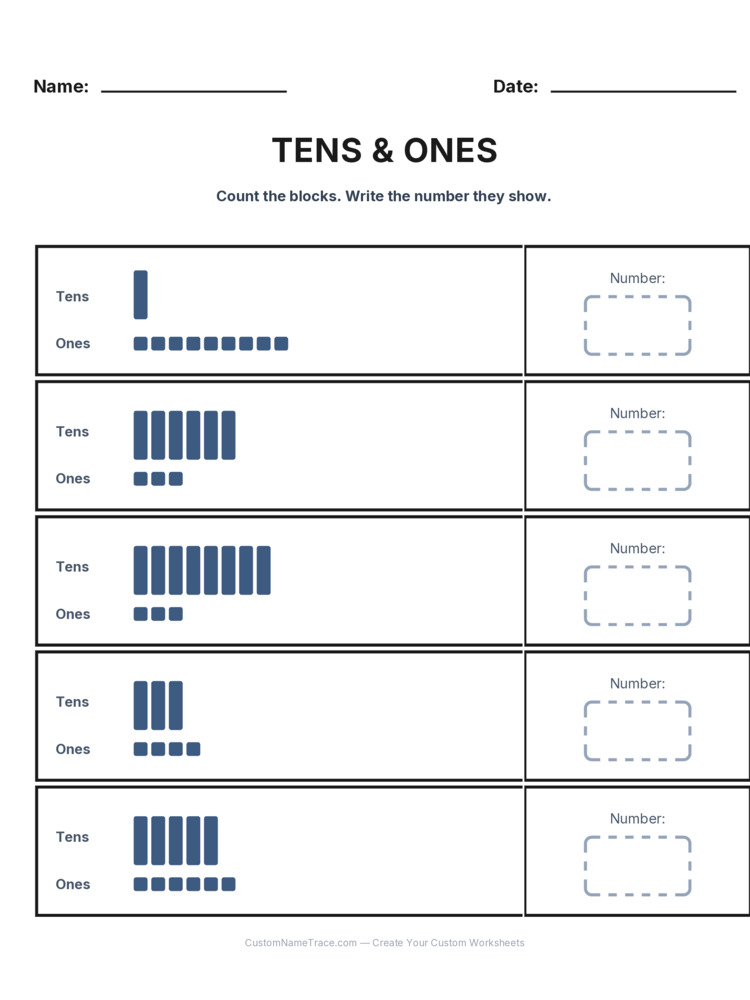
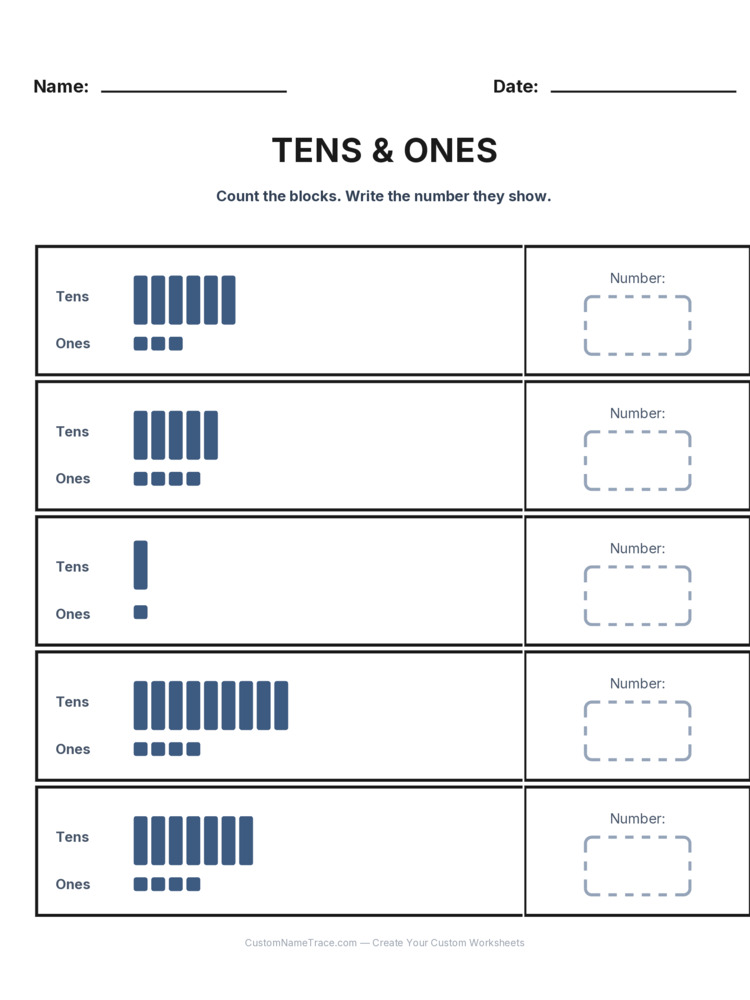
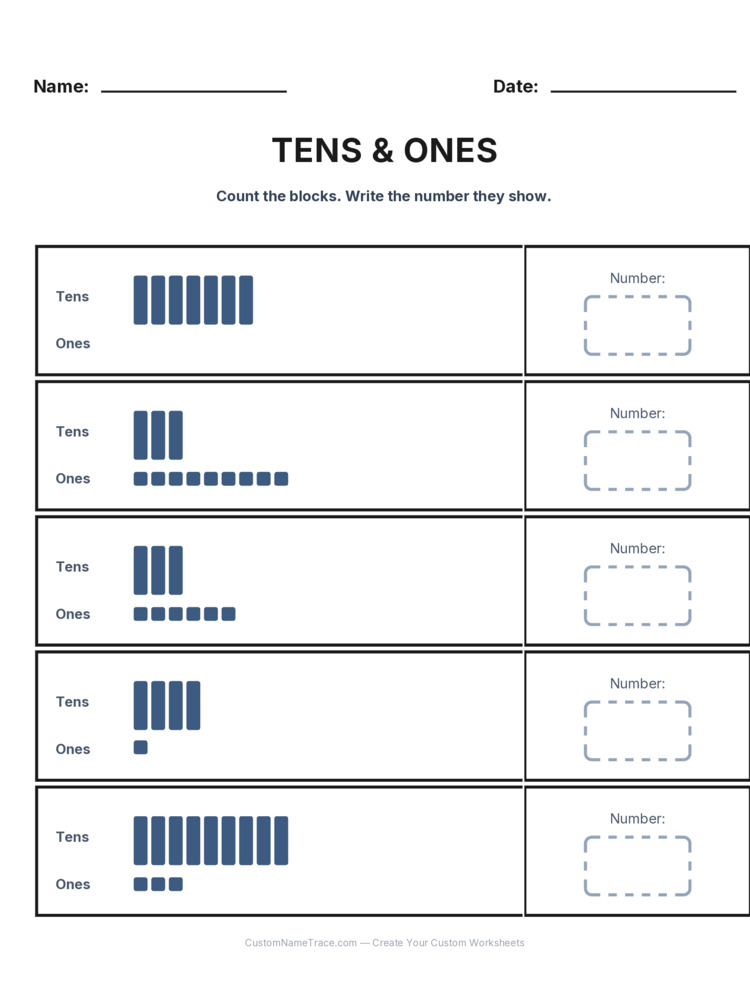
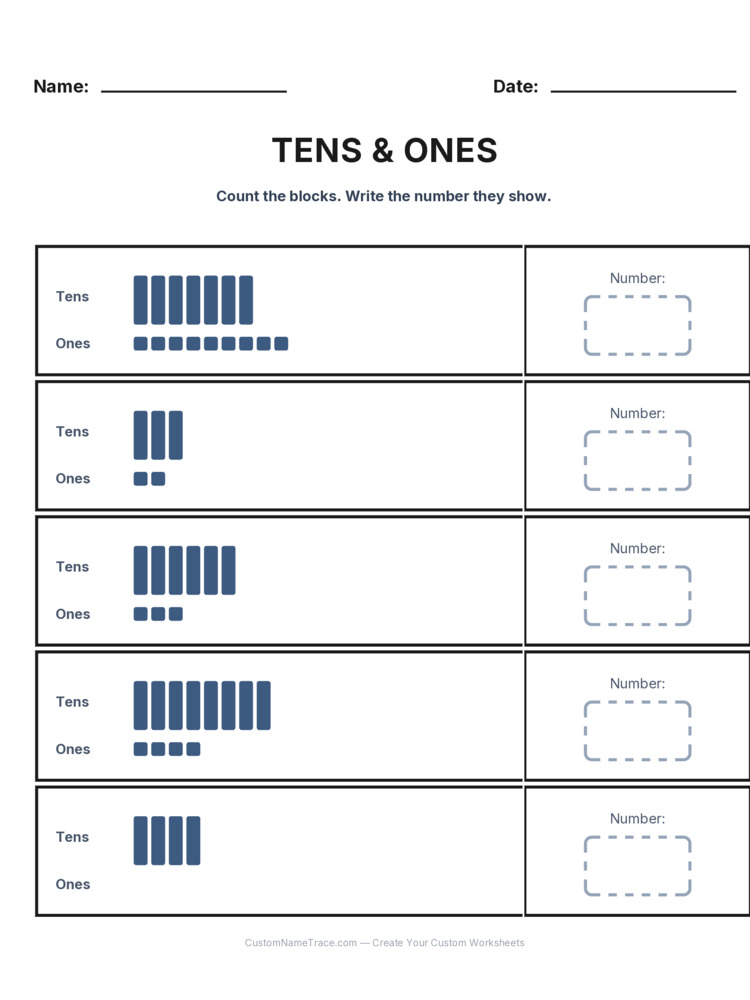
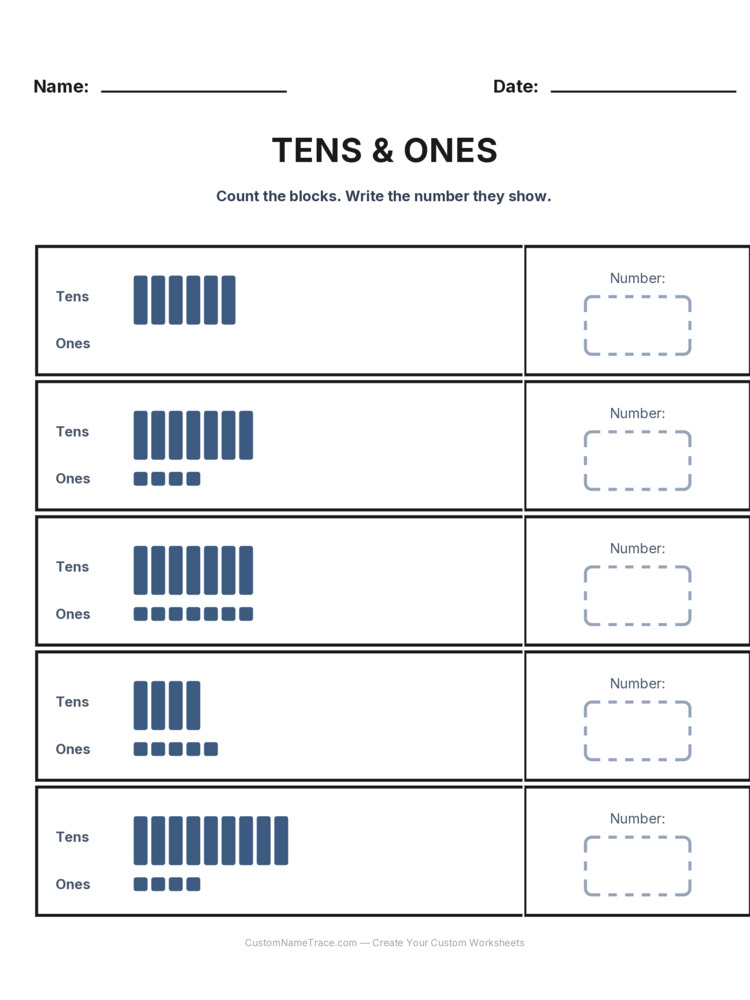
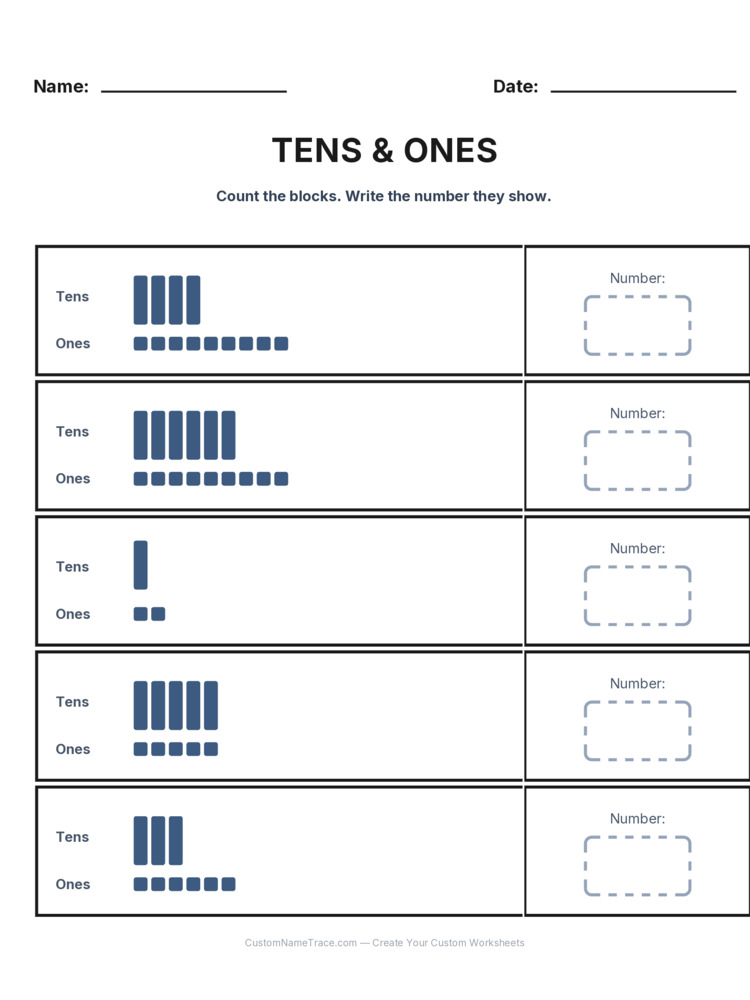
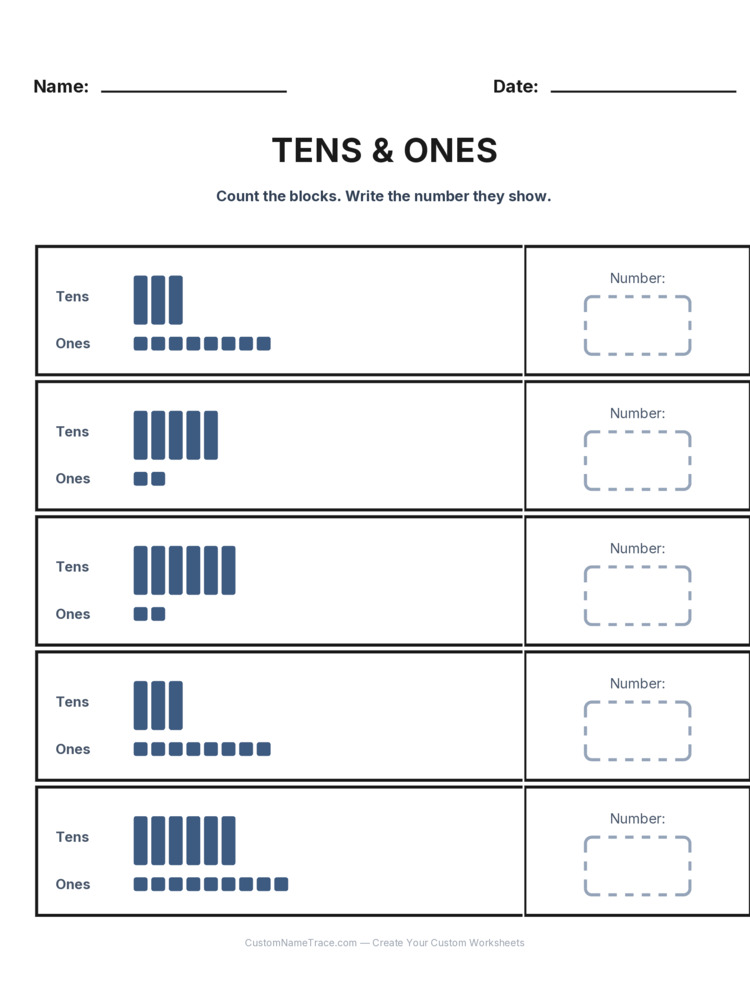
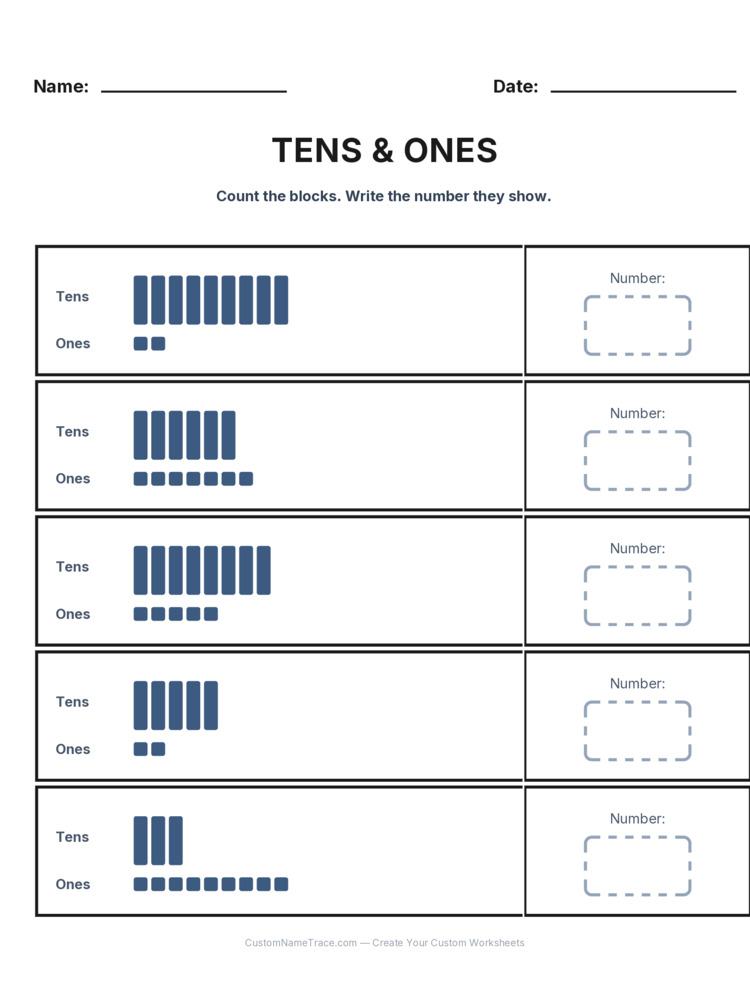
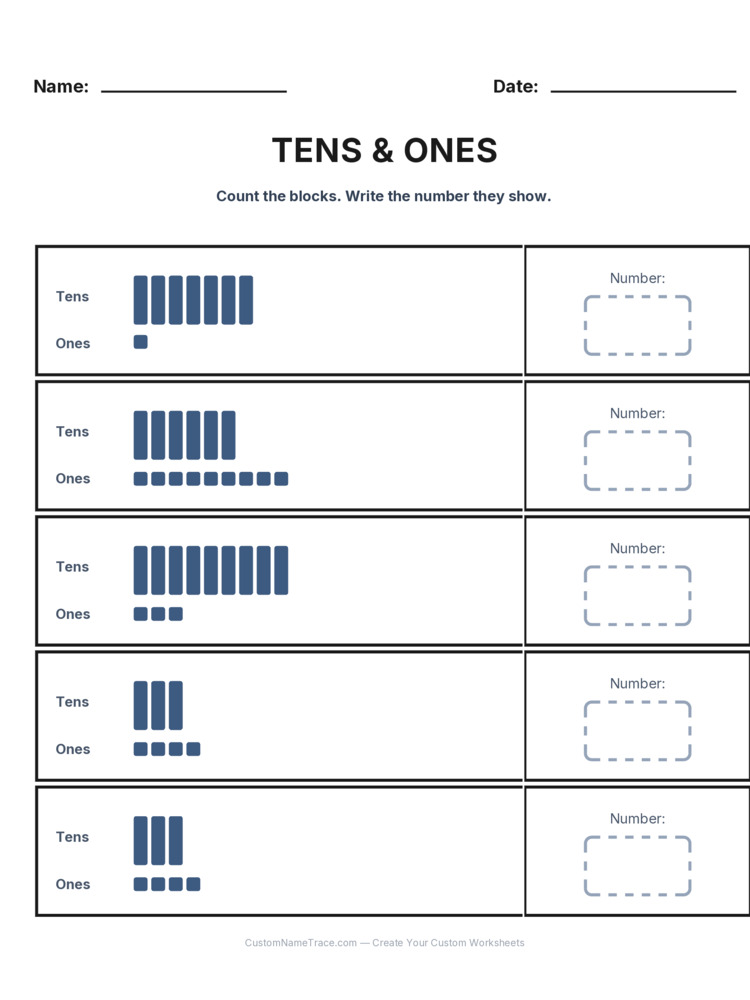
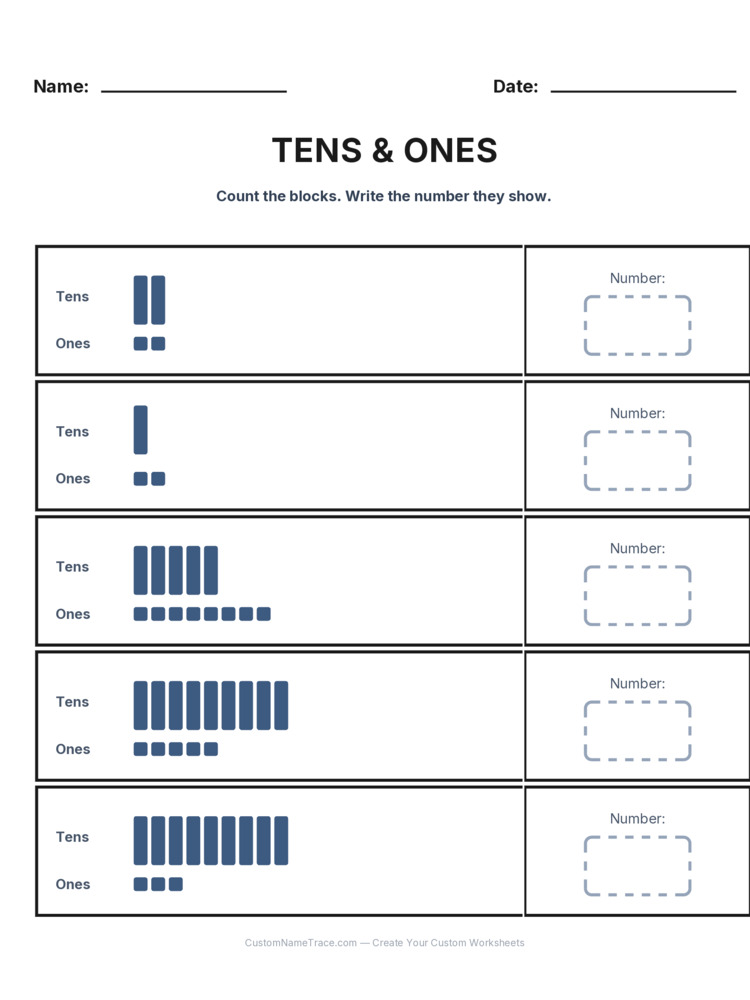
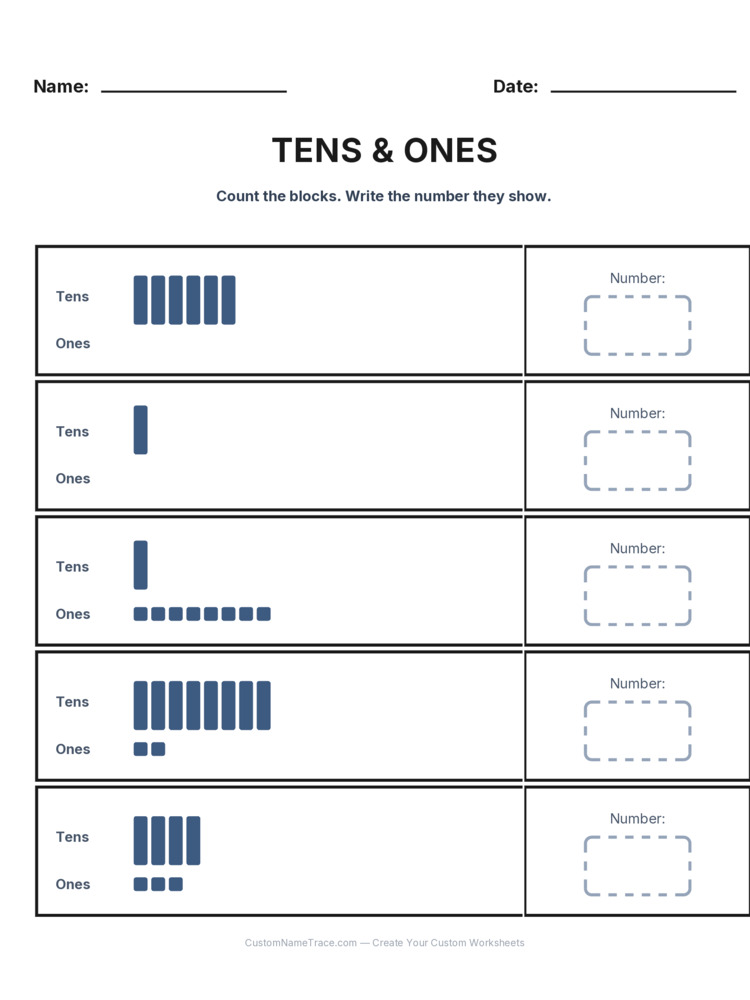
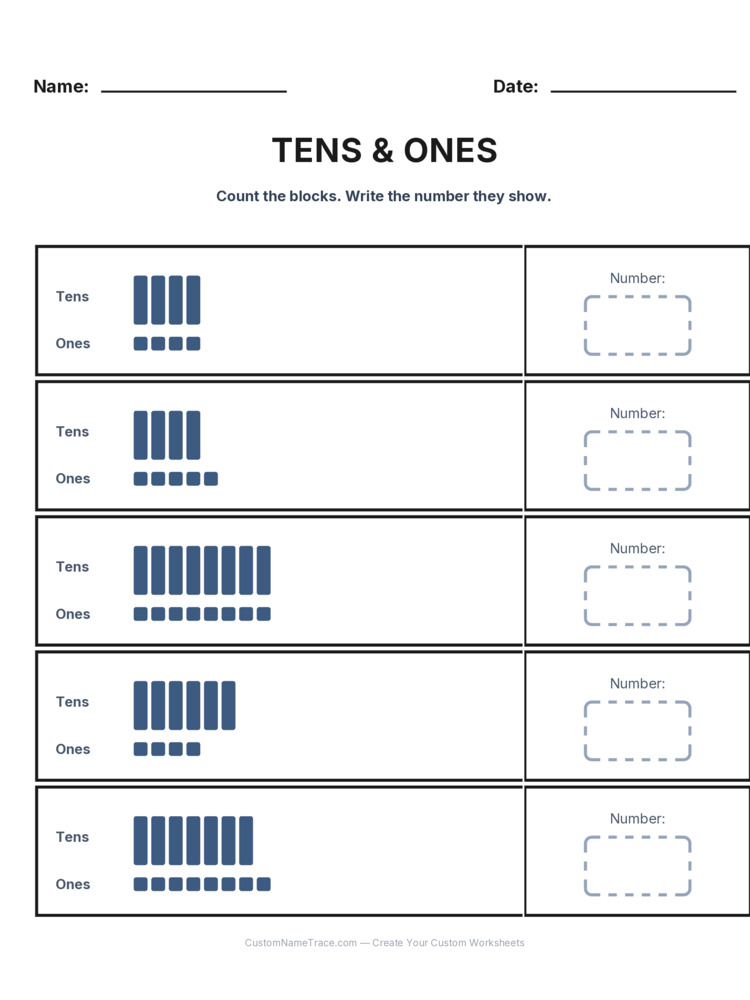
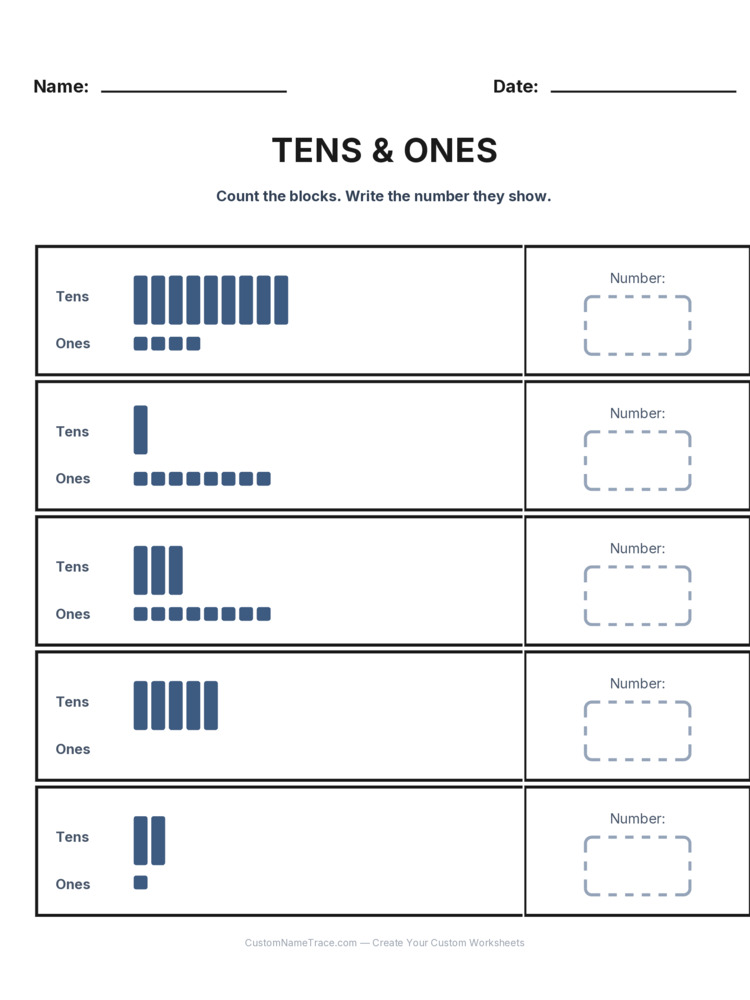
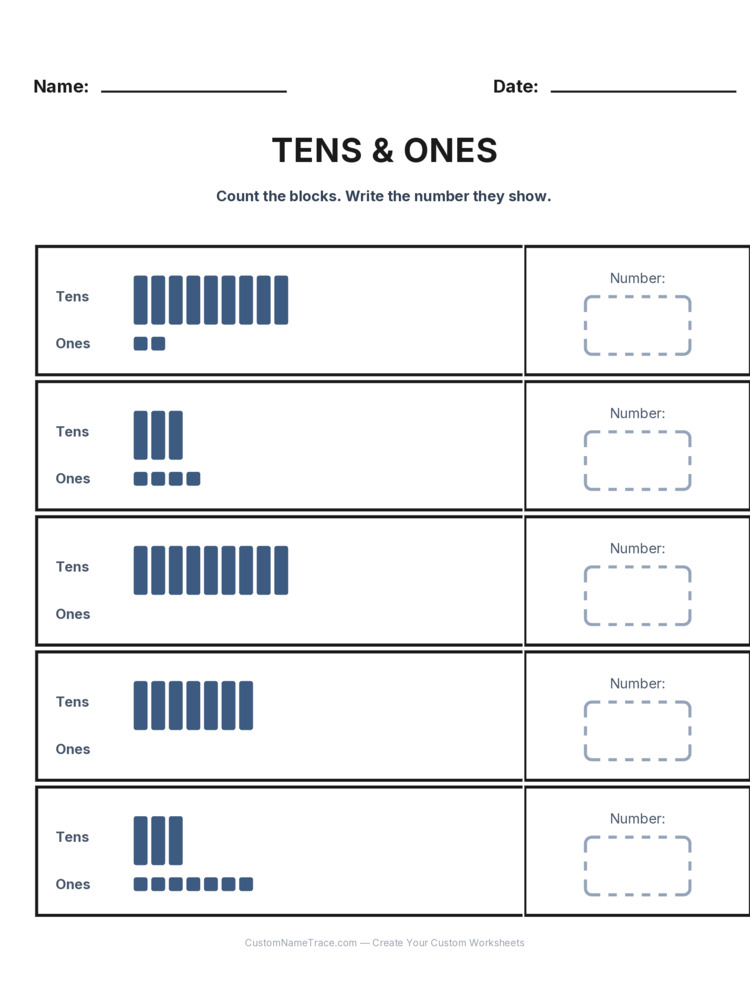
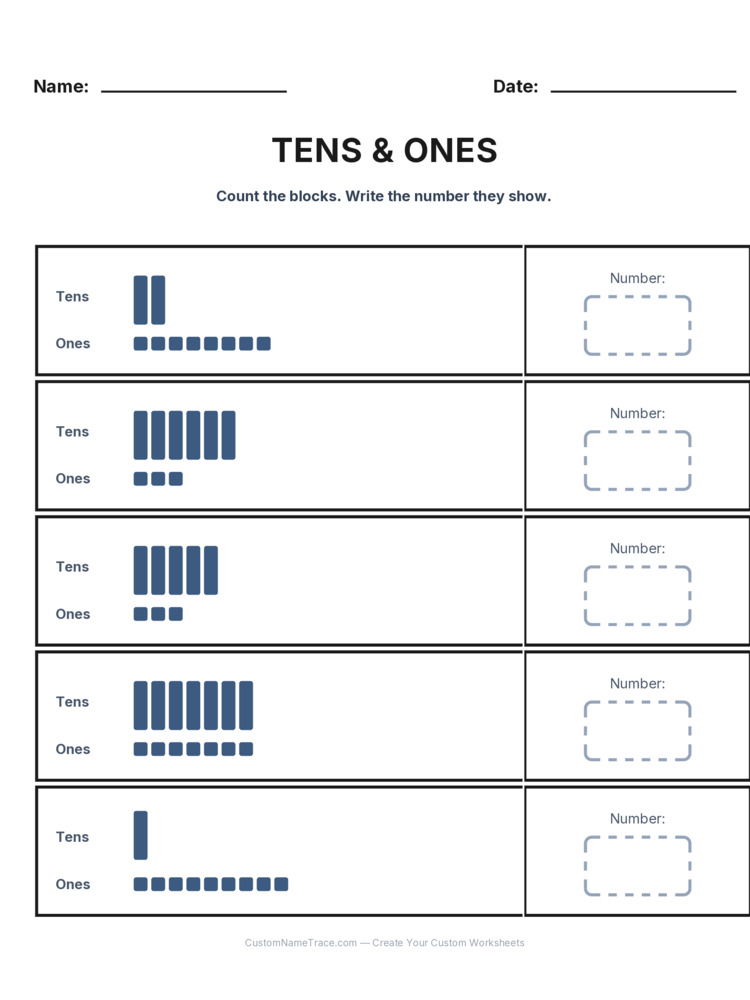
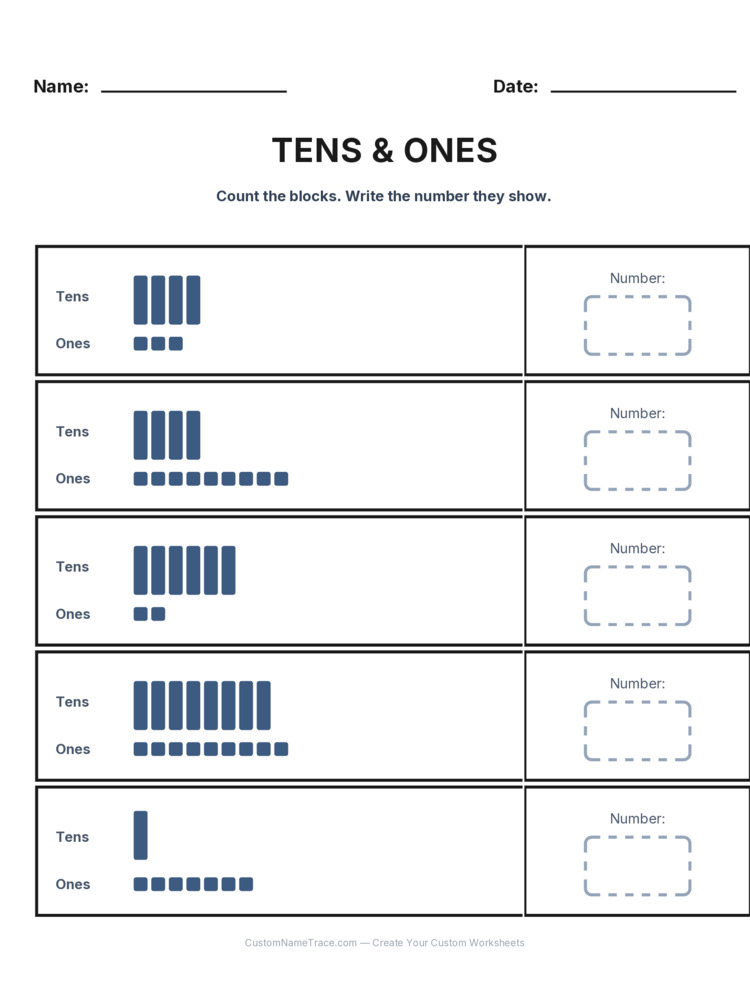
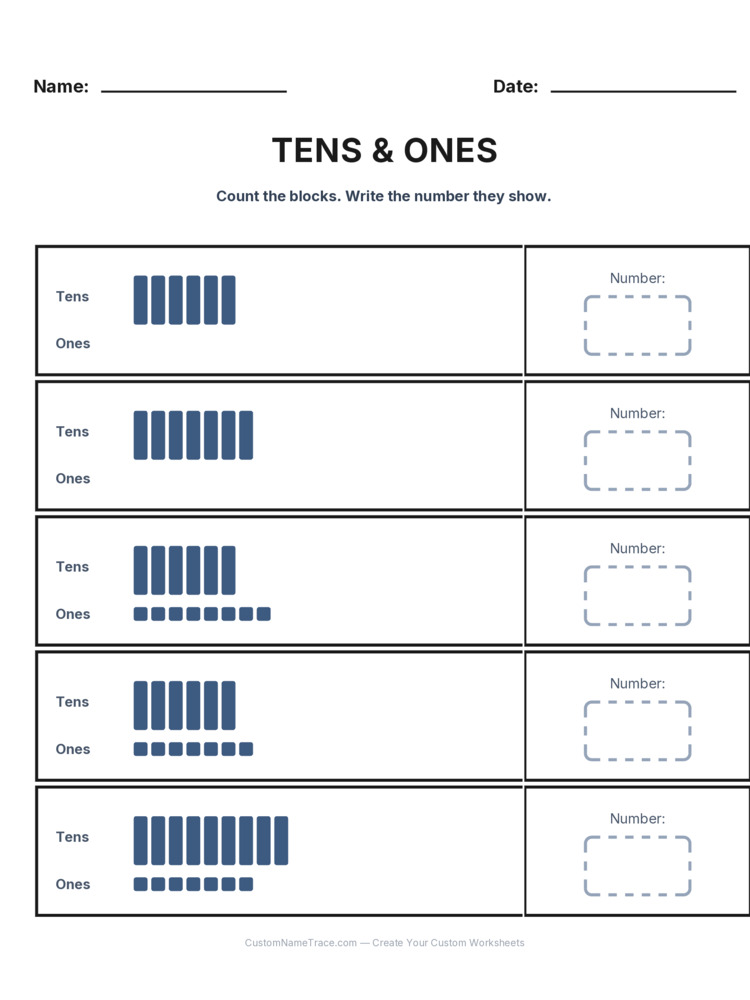
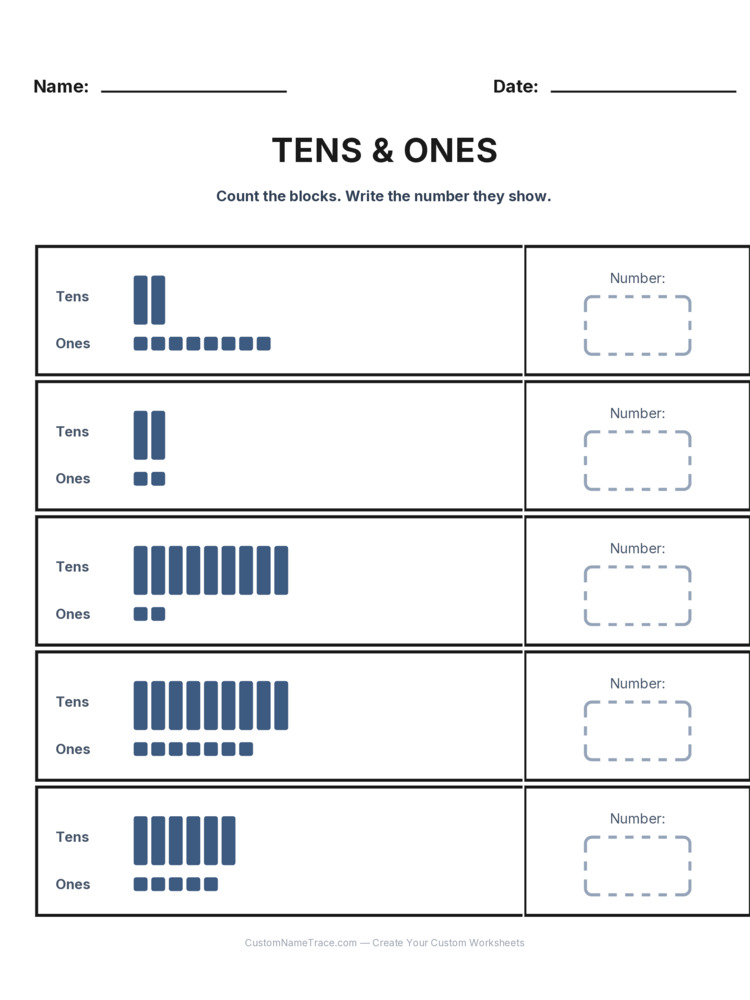
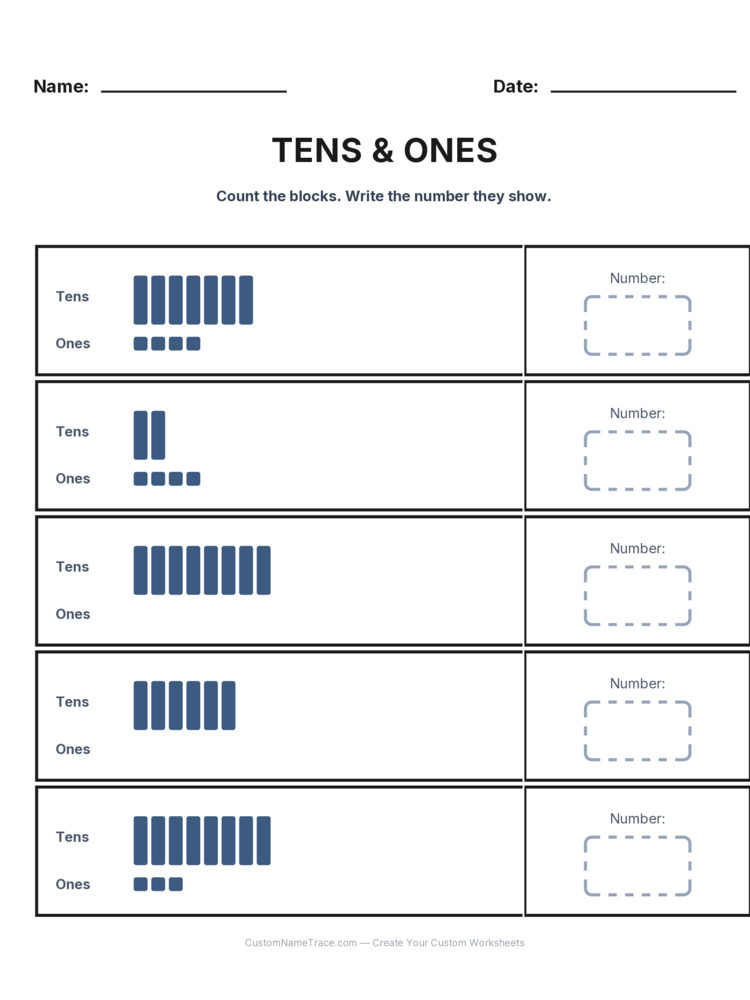
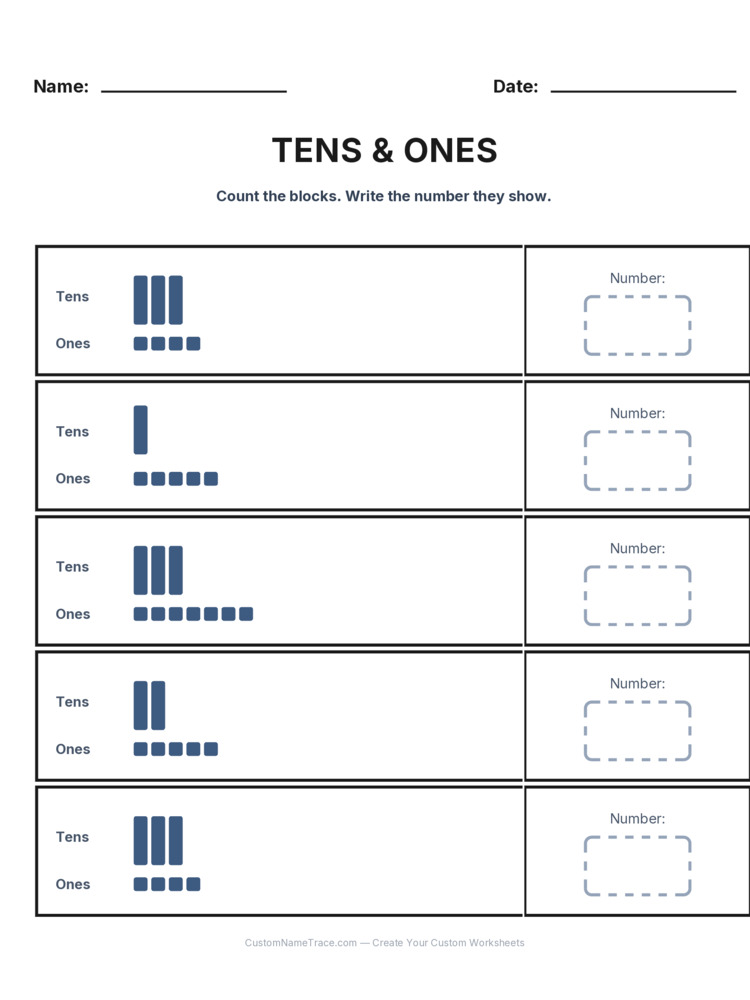
Each worksheet displays a set of base-ten blocks — individual unit blocks, and larger blocks representing a group of ten (and, at higher levels, a group of a hundred) — and asks a child to count what's shown and write the number it represents. This is one of the most widely used physical and visual models in elementary math instruction specifically because it makes an abstract idea — that the digit '3' in '35' is secretly worth thirty, not three — into something a child can see and count directly, rather than something that has to be taken on faith.
A tally mark represents exactly one; a base-ten 'tens' block represents ten units bundled together as a single visual unit, and that bundling is the entire point. Counting individual units gets slow and error-prone past a certain quantity, but counting a small number of ten-blocks plus a small number of leftover ones is fast and, more importantly, mirrors exactly how our written number system itself is structured — a number's tens digit literally counts bundles of ten, the same bundles this worksheet shows as blocks.
Unlike counting objects, where every item is worth exactly one no matter where it sits, a written numeral's digits are each worth a different amount purely based on position — the same digit '3' means three, thirty, or three hundred depending entirely on where it sits in the number. That positional-worth idea has no obvious real-world parallel a young child has already encountered, which is exactly why a concrete, countable model like base-ten blocks matters so much here: it gives an otherwise abstract rule something physical and visible to point to.
Calibrated to Grade 1, and a method that always works
This worksheet works with {digits}-digit numbers specifically, calibrated to Grade 1's curriculum level — an earlier stage works with tens and ones alone, while a more advanced version introduces a hundreds place, adding a third kind of block (a hundred-block, itself ten ten-blocks bundled together) to count alongside the tens and ones. The underlying skill — count each block type, multiply by its place value, add the results — is the same at every level; what changes is how many distinct place values a child has to track and combine at once.
Count the largest blocks first (hundreds, if present), then the tens blocks, then the individual ones, keeping a running total after each group rather than trying to combine everything at the end from memory. Writing each partial count down as it's found — 'two hundreds is 200, plus three tens is 30, so 230 so far' — externalizes a process a child would otherwise have to hold entirely in their head, and it's a habit worth teaching explicitly rather than assuming it develops on its own.
Writing the block count for each place value directly above or below where its digit will eventually go — hundreds count on the left, tens in the middle, ones on the right — before combining them into a single final number keeps the three separate counts from blending together in a child's head. This spatial habit, keeping each place value physically separate on the page until the very last step, catches the specific mistake of writing block counts as if they were separate small numbers side by side rather than combining them correctly into one larger number.
Common mistakes, and how to catch them
The most frequent error on this worksheet is writing down the number of blocks counted rather than the number those blocks represent — three tens-blocks and four ones-blocks becoming '34' by luck, or becoming '7' (three blocks plus four blocks) by genuine confusion about what a tens-block is actually worth. Asking directly, 'how much is one of the bigger blocks worth by itself?' before counting anything checks whether the core idea — a tens-block equals ten, not one — is actually solid before it gets buried inside a bigger calculation.
For a small number like 12 (one tens-block, two ones-blocks), a child who miscounts blocks as digits ("one block, two blocks, so 1 and 2, so 12") can accidentally land on the right answer without actually understanding place value at all — the coincidence only breaks down with a number like 30 (three tens-blocks, zero ones) or 45, where digit-counting and correct place-value reasoning clearly diverge. Working through a few examples specifically chosen to expose that gap, rather than only easy ones where a shortcut happens to work, is worth doing deliberately.
A child who writes 300 as 003 — technically counting correctly but placing hundreds where ones belong — usually understands the individual block quantities just fine but hasn't yet locked in which direction the place values increase when reading left to right. Consistently starting the count from the same side every time (always hundreds first, reading left to right, matching how the blocks are typically laid out) builds that directional habit far more reliably than correcting the mistake after it happens on each individual worksheet.
Making it concrete
After counting a set of blocks and arriving at a number, writing that numeral directly underneath its corresponding block groups — the hundreds-block count under where the hundreds digit will go, and so on — makes the connection between the physical count and the written digit explicit rather than implicit. That direct visual pairing is what eventually lets a child skip the blocks altogether and read a written number's place values directly, which is the actual long-term goal this worksheet is building toward.
Real base-ten block sets are widely available and worth using alongside this printed worksheet if accessible, since physically picking up and grouping blocks — bundling ten single units into a 'ten' by hand — builds an even more concrete sense of the bundling idea than looking at a printed picture of blocks already grouped. Short of real blocks, bundling ten pencils with a rubber band, or ten coins into a small cup, works as an improvised substitute for the same physical grouping experience.
Every block arrangement here is generated to have exactly one correct, unambiguous count — blocks are never drawn overlapping or partially obscured in a way that could genuinely be read two different ways, since the goal is testing place-value understanding specifically, not visual puzzle-solving on top of it. That clean, unambiguous presentation keeps the difficulty concentrated entirely on the actual math skill this worksheet is built to practice, the same design principle applied throughout every worksheet type on this site.
Where this leads
Place value fluency, built here through physical and visual block-counting, is the direct foundation for every multi-digit addition and subtraction method a child learns afterward — the entire logic of "carrying" or "regrouping" in column addition is really just an abstract, symbolic version of the physical bundling and unbundling this worksheet practices concretely. A child who's genuinely solid on what a tens-block or hundreds-block represents has a real head start once those operations are introduced formally.
Counting hundreds before tens before ones, every time, rather than in whatever order a child's eye happens to land on the blocks, builds a consistent habit that scales cleanly to larger numbers later — the same largest-to-smallest counting order used here is exactly how a much larger multi-digit number gets read and reasoned about further on.
Print at full size so individual blocks stay clearly countable and distinguishable from the larger bundled blocks — a shrunk page can make a tens-block and a ones-block harder to tell apart visually, which undermines the entire exercise. Every numbered variant generates a fresh block arrangement representing a different number, so repeat practice always means a genuinely new count.